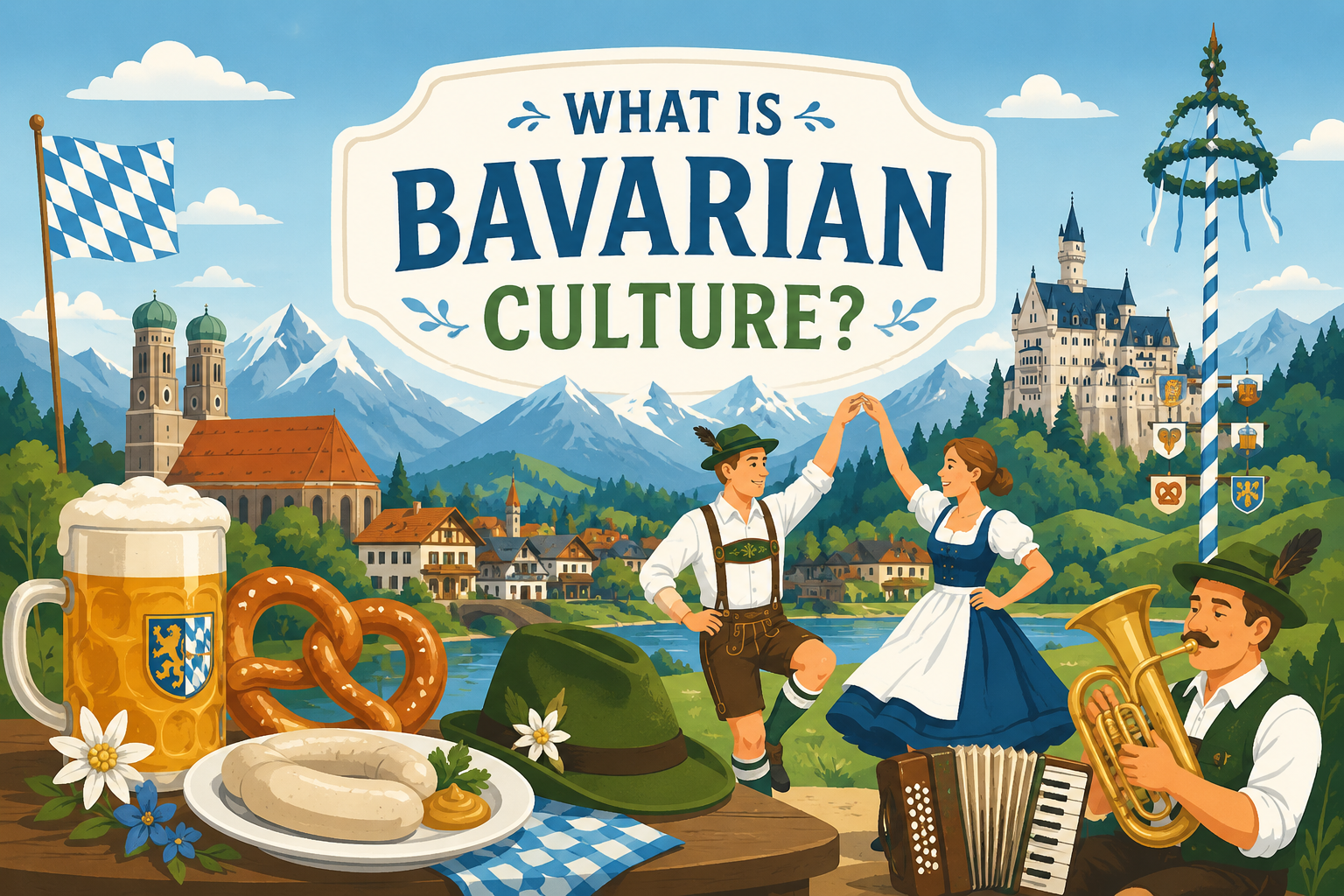
A packed beer hall tells you more about Bavaria than any textbook can. Long tables, brass music, fresh-poured lager, plates built for appetite, and strangers turning into tablemates by the second round – if you have ever wondered what is Bavarian culture, that scene is a strong place to start.
Bavarian culture is not just a costume, a festival, or a postcard image of the Alps. It is a living regional identity from southern Germany, shaped by local pride, Catholic tradition, agriculture, craftsmanship, and a deep love of gathering well. It feels festive on the surface, and it often is, but underneath the fun is a serious commitment to quality, ritual, and hospitality.
What Is Bavarian Culture at Its Core?
At its core, Bavarian culture is about belonging. Bavaria has a strong regional identity within Germany, and people from the region often think of themselves as distinctly Bavarian before anything else. That pride shows up in language, food, music, clothing, architecture, and the way social life is organized around clubs, festivals, family events, and local traditions.
The easiest mistake is to reduce Bavaria to Oktoberfest alone. Oktoberfest is famous for a reason, but Bavarian culture is much broader. It includes church holidays and village fairs, mountain traditions and urban beer halls, folk customs and modern city life. Munich may be the global symbol, but Bavarian culture also lives in smaller towns where brass bands rehearse weekly, bakeries open early, and seasonal celebrations still matter.
There is also a balance worth noticing. Bavarians can be deeply traditional and fully modern at the same time. You might see historic buildings beside sleek businesses, or old folk dress worn at a contemporary sporting event. That mix is part of the charm. The past is not treated like a museum piece. It is brought into everyday life.
The Beer Hall Spirit
If there is one social setting that captures Bavarian culture best, it is the beer hall and beer garden. These are not just places to drink. They are places to gather, relax, celebrate, sing, watch the match, mark a milestone, or simply spend a long afternoon in good company.
Beer in Bavaria carries heritage, discipline, and pride. Brewing traditions go back centuries, and quality matters. Bavarian beer culture is tied to local identity, to brewing methods, and to the idea that beer should be enjoyed in a social setting rather than rushed. The experience matters as much as the glass.
That is why communal tables feel so central. Bavarian hospitality has a social gravity to it. It invites conversation. It makes room for groups. It encourages a sense that everyone is here for a good time together, not sealed off in separate corners. In a true beer hall atmosphere, energy builds from the room itself – music, clinking steins, shared laughter, and that unmistakable sense that the night still has somewhere to go.
Food That Feeds the Occasion
Bavarian cuisine is hearty, direct, and built for real appetites. Think roasted meats, sausages, dumplings, schnitzel, pretzels, potato dishes, rich gravies, and comforting desserts. This is food with substance. It is meant to satisfy, and it is often designed to pair beautifully with beer.
But the deeper story is not just heaviness. Bavarian cooking values craftsmanship and consistency. A good pretzel should have the right chew and deep-baked finish. A proper roast should be tender, well-seasoned, and served with sides that make sense, not just fill the plate. The food is rustic, yes, but done right, it is precise in its own way.
Seasonality plays a role too. Some dishes are linked to holidays or colder weather, while others show up at festivals and public celebrations. Like many strong food cultures, Bavaria uses the table to reinforce identity. Meals are not only about eating. They are about ritual, generosity, and making guests feel welcome.
Music, Dress, and Celebration
Bavarian culture knows how to make an entrance. Brass bands, folk dancing, traditional songs, lederhosen, dirndls, decorated festival tents – these are some of the most recognizable elements, and they are not accidental. Public celebration is a major part of the culture.
Traditional clothing is a good example of how outsiders can get the wrong idea. Lederhosen and dirndls are sometimes treated like novelty costumes in the US. In Bavaria, they can carry regional pride and family tradition. They are often worn for festivals, weddings, religious events, and local gatherings. It can be playful, but it is not purely theatrical.
Music works the same way. Oompah-style brass music is the image many Americans know, and it absolutely belongs in the conversation. But Bavarian music culture is broader than that, stretching from folk ensembles to modern party bands that keep festival energy alive late into the evening. The through line is participation. Bavarian celebration is rarely passive. People sing, clap, toast, and join in.
Faith, Ritual, and Regional Identity
To understand what is Bavarian culture, you also have to look past the party and into the calendar. Bavaria has historically been strongly Catholic, and that has shaped public holidays, seasonal customs, processions, church festivals, and community life. Even for people who are not deeply religious, those rhythms still influence local identity.
This matters because Bavarian culture is not only about entertainment. It is also about continuity. Customs are passed down through families, clubs, parishes, and neighborhoods. Children grow up seeing the same festivals return each year. Traditions are repeated, but not mechanically. They are repeated because they reinforce community.
That regional identity is one reason Bavaria feels so distinct. Germany is not culturally uniform, and Bavaria stands out for how visibly it preserves its traditions. The accent is different. The customs are different. The food culture is different. Even the posture toward public festivity feels different – more overt, more ceremonial, and often more communal.
Hospitality Is a Big Part of the Answer
One of the clearest answers to what is Bavarian culture is simple: making people feel welcome at the table. Bavarian hospitality has warmth to it, but it also has momentum. Guests are not just served. They are brought into the atmosphere.
That can mean a full festival crowd, a family meal, or a group event where the point is to celebrate loudly and well. The host’s job is not merely efficiency. It is to create an experience with generosity, rhythm, and spirit. That is why Bavarian spaces often feel lively instead of polished in a formal way. They are built for enjoyment.
There is a trade-off here, of course. If someone prefers a quiet, minimalist dining room, a true Bavarian environment may feel a little too energetic. But that is part of its identity. Bavarian culture leans into shared joy. It is not trying to be restrained.
Why Americans Connect With It
Bavarian culture travels well because it taps into things people already love – great beer, satisfying food, live music, sports, celebration, and the feeling that a night out should actually feel like an event. For American audiences, especially in a city that thrives on entertainment and group energy, the appeal makes perfect sense.
It also offers something many modern dining experiences do not. A lot of restaurants are built around speed, aesthetics, or exclusivity. Bavarian culture is built around atmosphere and participation. It invites you to stay awhile. It gives a group something to do, not just something to order.
That is part of why authentic Bavarian hospitality still resonates so strongly in the US. It feels generous. It feels memorable. And when it is done right, it never feels like a theme. It feels like a tradition with real heartbeat.
At places like Hofbräuhaus Las Vegas, that heartbeat is exactly the point – not just serving Bavarian favorites, but bringing the beer hall spirit, the music, and the communal energy to life in a way people can feel the moment they walk in.
So, What Is Bavarian Culture?
It is proud but welcoming, traditional but lively, regional but instantly recognizable. It is the sound of brass music over a full room, the weight of a stein in hand, the comfort of a meal made with intention, and the pull of a table where celebration comes naturally.
If you want to understand Bavarian culture, do not start with a definition alone. Start with the experience. Sit down where people are laughing, the beer is flowing, the food comes out hot, and the whole room seems to be in on the same good time. That is where Bavaria makes the most sense.